Pavilion from the Ocean

Pavilion from the Ocean

Welcome to iPavilionCondo.com

This forum, by owners for owners, provides useful information for owners to view and discuss.

This blog does not belong nor represents the views of the Pavilon Condo Association

You can subscribe to the blog by entering your email on the upper hand side on the blog. You will then receive an email with a link that you must click on to complete the subscription. Then every time the blog is updated you will receive an email message.

Feds Shift Focus to Money Laundering in Miami Real Estate


The Financial Crimes Enforcement Network, a bureau of the U.S. Treasury Department, recently issued geographic targeting orders in Miami-Dade County and Manhattan that will require certain insurance title companies to identify and report the "all cash" buyers of high-end residential real estate.

FinCEN issued the orders after growing concerned over the last year that criminals — corrupt foreign officials, narcotics traffickers and others — have hidden behind anonymous limited liability companies and cash purchases of high-end real estate to launder dirty money. The orders will be in effect from March 1 to Aug. 27. I explore why FinCEN likely felt compelled to issue the orders, what to expect will happen next and who should consider retaining legal counsel.

Why FinCEN Acted

FinCEN's stated mission is "to safeguard the financial system from illicit use and combat money laundering and promote national security through the collection, analysis and dissemination of financial intelligence and strategic use of financial authorities." Although the risk of money laundering through purchases of residential real estate is not new, the last year saw a renewed focus on this risk. For example, last year the New York Times published a widely read series, "Towers of Secrecy: Piercing the Shell Companies," that analyzed multimillion-dollar real estate purchases in Manhattan's Time Warner Center overlooking Central Park. After examining a decade of ownership, the series found more than 200 shell companies had been used to buy the Time Warner Center condominiums. The buyers were increasingly wealthy foreigners, several of whom were government officials and/or the subject of government investigations. In response to the series, FinCEN said the potential abuse of the real estate sector was a "fundamental priority."

Last spring, FinCEN Director Jennifer Shasky acknowledged the historic risk posed by real estate-based money laundering and even made pointed reference to the "wild, narcotics-fueled days of the 1980s" that led to "the endemic use of narcotics proceeds to fund the purchase of luxury real estate in Miami."

Observing that the past is often prologue, Shasky said corrupt politicians, drug traffickers and other criminals are currently using cash-only purchases in the names of LLCs to obfuscate the identities of true owners. Money launderers use LLCs to buy real estate because many states do not require LLCs to disclose the identity of the beneficial owner, thereby providing the anonymity that criminals seek. Other gaps in the law also make money laundering through real estate attractive to criminals who are flush with cash. For example, although real estate purchases involving a mortgage are subject to certain anti-money laundering and due diligence requirements, purchases that are 100 percent cash are not.

What To Expect Next

Title insurance companies that must produce beneficial owner information to FinCEN will likely want to retain legal counsel. Legal counsel can advise the company how to proceed with FinCEN, they can help manage the production of documents, and they can field any questions or follow-up requests from FinCEN. Significantly, legal counsel can also conduct a privileged internal investigation and advise the company of any potential criminal or civil legal exposure to the company or its employees under the protection of the attorney-client privilege.

Once FinCEN compiles the identities of the beneficial owners behind the LLCs, that information will likely be used by the U.S. Attorneys' Offices in Miami and Manhattan to generate potential leads for investigations. To build those cases, prosecutors will issue grand jury subpoenas to banks, real estate brokers, title insurance companies, and others for testimony and/or the production of documents. Subpoenaed entities or individuals should seek legal counsel to advise them of their rights and have legal counsel respond to law enforcement request for information.

Real estate professionals who facilitated real estate transactions are unlikely to be the targets of the government's investigations, unless there is evidence that a broker, lawyer or other real estate professional knew (or willfully avoided learning) that the properties were purchased with dirty money.

Instead, law enforcement will likely focus on bringing criminal money laundering charges against the beneficial owners and will seek to forfeit the tainted properties to the United States. Prosecutors can charge a property buyer with money laundering if the buyer purchased a property with what he knew were illicit funds for the purpose of concealing or disguising the nature, source, ownership or control of the illicit funds. Of course, any buyer who becomes the target of a government investigation would be wise to immediately retain legal counsel.

Seizure And Forfeiture

After compiling the data sought by FinCEN's orders, law enforcement will likely cross-reference the names of beneficial owners against other law enforcement databases to identify matches and look for patterns. One database that law enforcement is sure to check is the specially designated nationals list kept by Treasury's Office of Foreign Assets Control.

That list contains the names of individuals and companies that have been tied to terrorism and narcotics trafficking. U.S. citizens are prohibited from dealing with people or companies on the list. Any person on the OFAC list who owns property in the United States should expect to see their property seized and subject to forfeiture.

Law enforcement will also review suspicious activity reports and currency transaction reports, which are commonly filed by financial institutions such as banks. The government uses those reports to generate leads for investigations and to trace criminal proceeds.

In some cases, the government may use its civil forfeiture powers to take ownership of the property tied to criminal activity. A civil forfeiture lawsuit is an action in rem, meaning it is brought against the property, known as the res, not against a natural person.

The government will also likely share the information it obtains from FinCEN with foreign governments that have filed requests for assistance in gathering evidence pursuant to mutual legal assistance treaties and other international compacts.

Finally, if the geographic targeting orders reveal what FinCEN suspects — a strong link between high-end, cash residential real estate purchases and money laundering in Miami and Manhattan — you can expect FinCEN to address the regulatory gaps that allowed real estate to become an attractive vehicle for money laundering.

New condo project slated for Miami’s Upper East Side


Prices start at $600,000 for units at Boulevard 57
Eight-story project has 107 units
MiMo District experiencing a renaissance but not much residential development

Developers are launching sales for an eight-story condo tower in Miami’s Upper East Side, the trendy neighborhood along Biscayne Boulevard that has barely been touched by South Florida’s luxury condo boom.

The 107-unit project, at 5700 Biscayne Blvd., will include 45,000 square feet of commercial and retail space on the ground floor, as well as an infinity pool, fitness studio and tavern. Prices start at $600,000 for a 1,120-square-foot one-bedroom apartment and go up to $2.7 million for a 4,600-square-foot penthouse.

Boulevard 57 is launching at a difficult time for the condo market. Slowdowns in Latin America and Europe have hurt the foreign buyers who’ve fueled the boom. Developer Hector Torres of Unitas Group Development said Boulevard 57 will be geared towards locals, despite a 50 percent deposit structure that usually appeals more to foreign than domestic buyers. Locals tend to prefer buying homes with financing rather than cash.

“A lot of the domestic buyers are paying that today in other developments,” Torres wrote in an email. “The demand is strong. Buyers love the walkability of the neighborhood, the schools and the proximity to downtown Miami [and] Brickell.”

One Sotheby’s International Realty is handling sales. Sieger Suarez Architects will design the building.

Previous developers have tried and failed to build on the site. A project called Kubik was originally planned for the 2.3-acre parcel on the west side of Biscayne Boulevard in 2008 but was held up as neighbors protested its 12-story height. Those developers then sold out to the Green Dragon Group for $15 million in 2014 before Unitas took over the project the next year. This is the group’s first development.

Despite a renaissance of new restaurants, hotels and bars along Biscayne Boulevard in Miami’s MiMo District, the Upper East Side hasn’t seen much new residential development.

One exception is Baltus House, a Related Group project near the Design District that opened last year. Farther north, at 7880 Biscayne Blvd., developers are turning the old U.S. Immigration Naturalization Service building into a mixed-use project with 324 condo units called Triton Center.


Real Estate/Ahead of the Deal: Is this the end of a golden era for South Florida condo development?


As local history is written, the first month of 2016 could well mark the peak of a golden-era period for high-rise condo development in the tricounty South Florida region of Miami-Dade, Broward and Palm Beach.

Since the 1980s, developers have practically every decade initiated a series of condo building booms to capitalize on the strong demand from out-of-town buyers for South Florida units.

Foreign and domestic investors alike have proved over the years to have a strong interest in owning residential properties in this sunny, international business center with no state income tax that markets itself as the gateway to Latin America.

Inevitably, the high-rise condo market booms have been subsequently followed by predictable busts.
The downturns have consistently created buying opportunities for new generations of discount-oriented investors who typically gobble up unsold units that can be rented out in the short term before ultimately being resold at handsome profits in later years.

Despite the well-documented history of booms and busts in South Florida, all of the key players — developers, investors and lenders — have continued to participate in these cycles time and again, given the potential rewards achieved by those who take on the risk.

After all, South Florida residential real estate — much like technology stocks — has always seemed to bounce back to new highs after periods of hard economic times.

Consider that even though South Florida’s residential real estate markets crashed spectacularly during the last decade, developers now have more than 400 new condo buildings with nearly 49,600 units in the pipeline for sites east of Interstate 95 in the tricounty region, according to the preconstruction condo projects website CraneSpotters.com.

(For disclosure, my firm operates the website.)

Out-of-town investors from Latin America, North America and Europe played an influential role in buying up the excessive supply of units from the previous cycle as well as actively paying record prices in the current South Florida boom.

Given this region’s high-rise history, a pair of political moves initiated earlier this month in Washington, D.C., has the potential to dramatically change the makeup of South Florida’s condo market going forward.

On Jan. 12, President Barack Obama called for ending the more than 50-year-long U.S. embargo on Cuba at a time when South Florida residential real estate is increasingly competing for buyers against other areas in the Americas, including the booming condo market in Panama.

It is unclear if the U.S. embargo against Cuba will be lifted during the remaining term of his presidency but Obama’s efforts to normalize relations with the communist country to the south is generating tremendous curiosity amongst U.S. residents who want to at the very least to have a legal means for visiting the Caribbean island.

It goes without saying, South Florida and much of the Caribbean are sure to feel the impact of U.S. tourists focusing their tourism and investment dollars on Cuba.

It is not to say that investors will bypass possible residential real estate deals in South Florida in hopes of being able to someday buy in Cuba. Still, the possibility is something many investors will probably want to evaluate before making a final decision.

A day after Obama’s call to “lift the embargo” on Cuba, the U.S. Treasury Department’s Financial Crimes Enforcement Network bureau issued a temporary directive on Jan. 13 targeting all-cash buyers involved in luxury residential real estate transactions of at least $1 million each in Miami-Dade County and the New York City Borough of Manhattan.

The move by the Feds calls for title insurance companies to report “the beneficial ownership information of legal entities purchasing certain high-value residential real estate without external financing,” according to a FinCEN statement.

The Feds want to know more about the “natural persons” who are ultimately behind the wave of third-party entities — or “shell companies” — that have been purchasing South Florida luxury condos with cash to ensure that illicit funds are not being used to complete these transactions.
“We are seeking to understand the risk that corrupt foreign officials, or transnational criminals, may be using premium U.S. real estate to secretly invest millions in dirty money,” FinCEN Director Jennifer Shasky Calvery said in a statement announcing the six-month directive that is scheduled to begin in March.

It is unclear if the FinCEN order will become permanent or be expanded to include Broward and Palm Beach that along with Miami-Dade make up the tricounty South Florida region.
The South Florida condo market — reinforced by the banking, legal and transportation infrastructure of the United States — has long been viewed as a safe harbor by international investors who want to protect their capital, maintain their personal security and possibly even make a profit.
Wealth preservation and individual security rather than pricing are said to be crucial factors influencing many of the South Florida condo investors who are from foreign countries where economic and social issues are much less predictable than in the United States.

Based on the volume of all-cash deals for residential real estate in South Florida in recent years, it is reasonable for the Feds to examine whether illicit funds may have been invested in the tricounty region.

The unanswered question going forward is what the Feds will discover and ultimately do to maintain the integrity of current anti-money laundering laws while balancing the importance of international investors to South Florida’s luxury residential real estate market.

Peter Zalewski is a principal with the Miami real estate consultancy Condo Vultures. Zalewski, a licensed Florida real estate professional since 1995 and founder of CVR Realty and Condo Vultures Realty LLC, advises developers, lenders and institutional investors. Zalewski also runs the preconstruction condo project website CraneSpotters.com in conjunction with the Miami Association Of Realtors.

Home Prices Jump in December, Posting Biggest Increase in Almost Two Years


Home prices rose 8.8 percent in December from a year ago, the biggest increase in 22 months. Sales were strong too, up 7.7 percent despite a lack of supply that’s challenging homebuyers. There were fewer homes for sale in December than in any month of 2015.

Market SummaryDecember 2015Month-Over-MonthYear-Over-Year
Median sale price$267,5001.6%8.8%
Homes sold164,30022.7%7.7%
New listings130,300-21.8%3.3%
All Homes for sale488,600-10.3%-5.4%
Median days on market410-7
Off market in 2 weeks25.9%-0.9%4.5%
Months of supply3-1.1-0.4
Sold above list17.3%-0.8%.1%
Average Sale-to-list91.1%-0.3%0.1%
Typically, home prices slow along with sales in December. Last month, however, prices spiked due to a dearth of properties on the market. In December, there was a three-month supply of homes for sale, a steep slide from the 4.1 months reported in November. The lack of inventory supported a fast market, where the typical home sold in 41 days, a week faster than a year ago.

“In early December, I had five new listings, all of which received offers within about the first week,”  said Christy Alwin, a Redfin agent in Naperville, Ill. “Four had multiple offers. In the end, they were all under contract in less than 18 days. Inventory is low and buyers pounce on new listings as soon as they are available.”

Sales rose 7.7 percent year-over-year, compared to 2.8 percent the previous month, continuing a recent pattern of sales rebounding in December from November. In 2014, December sales grew 9.7 percent after dropping 0.7 percent in November. This seasonal trend casts doubt on the theory that a new mortgage rule, known as TRID or Know Before You Owe, had a significant impact on November or December sales volume.

In total, there were nearly 2 million homes sold (1,969,814 to be exact) in 68 markets tracked by Redfin in 2015, leading to a strong 9.6 percent increase from 2014.

Other December Highlights

Prices
  • The median sale price in Hudson Valley, NY, climbed 15.1% from November, posting the biggest gains of any market. Year over year, prices were up 6.3%.
  • Twenty-two metro areas continued their double-digit, year-over-year price growth in December, including San Jose (19%), Tacoma, WA, (13.9%), and San Antonio, TX, (11%).
  • Only three of 69 metros saw year-over-year price declines in December. In Tulsa, OK, prices fell by 4.4% to $142,000 in December, the largest year-over-year decline of any city that month.  Washington, D.C., (-2.8%) and Little Rock, AR, (-2.6%), also posted year-over-year declines.
Sales
  • Sales rebounded across the country in December from November, with 64 of 68 markets posting double digit, month-over-month increases. San Jose (71%), San Francisco (29.7%) and, and Nashville (20.2%) had the biggest increase compared to last year.
  • Only eight cities saw sales declines in December from a year ago. The largest year-over-year decreases were in Dayton, OH, (-10.7%), Buffalo, NY, (-7.2%) and Miami (-6.8%).
Competition and Speed
  • Denver and Oakland tied for the fastest markets, with half of all new listings selling in 18 days or less, followed closely by Seattle where the typical home sold in less than three weeks.
  • Bay Area metros San Francisco, Oakland and San Jose were the only cities where, on average, homes sold above list in December. In San Jose, 80% of Redfin offers faced competition. In Oakland 78.6% had multiple offers and in San Francisco the number was 70.6%.
Homes For Sale

  • New listings surged at year end in Miami (58.3%) and Fort Lauderdale (26.9%), where sellers see demand from vacation homebuyers. New for-sale listings were up an astounding 80.4% in Miami from a year ago; sellers put more properties on the market in December than in any other month of 2015. Inventory in Miami is up 11.3% year-over-year.
  • Houston and the Hudson Valley had the largest increase in homes for sale compared to last year. Inventory was up 32.8% and 26.5% in these metros, respectively
  • Two metros had less than a month of supply, Oakland (0.7) and  San Francisco (0.9). Eight additional metros had less than two months of supply, including San Jose, Seattle, Denver, Portland, San Diego, Dallas, Ventura County and Tacoma.
  • Good to know: Election fraud

    “Are you astonished Aulus, that our friend Fabullinus is so frequently deceived? A good man has always something to learn in regard to fraud.”
    —Marcus Aurelius

    Most condo owners do not know how board elections are suppose to be run so that the elections are fair and reflect their true desires. This ignorance gives the incumbents, the property manager and the condo lawyer the ability to manipulate the process.

    Board elections are often manipulated by board presidents, property managers and lawyers who do know what they are doing and have no desire to lose cash-cow accounts.

    When Florida appointed America’s first Condominium Ombudsman, one task he had was to appoint election monitors to conduct board of director elections. Preventing election misconduct and manipulation was seen as a priority.

    In his book, Condo Board Election Revolt, Valmore Lucier listed 50 different ways condo elections in Florida were tampered with. I have not come across that many stunts but after talking with condo owners here in the Greater Toronto Area, I have complied a fairly impressive list.

    1.The AGM package requests that owners drop off their completed proxies at the management office. Then, manager can:
    a.) Encourage owners to change their proxy.
    b.) A few of the proxies, that support a challenger to the incumbents
         disappear.
    2.A senior lives in a unit that is registered in her son's name and hands in a proxy. It is accepted only if it helps the incumbents.
    3. If a board-friendly owner is in arrears for more than 30 days, his proxy will be accepted.
    4.At a recent special owners meeting, a proxy was submitted for an owner who died two months prior to the mailing of the meeting information packages.
    5.Altering a candidate's election leaflet by removing the second language text that is read by 65% of the owners that can't read English.
    6.The property manager manned the registration desk. When registration was complete, he left the room to converse with the president. It was obvious that the owners will replace the entire three-person board so the manager returned to the meeting room and told the owners that the meeting was cancelled because the president, despite having four security guards hired for the occasion, was afraid for his personal safety. So, no meeting, no vote, no change.
    7.Telling absentee owners that they can sign their name to their blank proxy and they will fill in the rest.
    8.When a board-friendly owner, (who has already handed in a proxy), shows up, the registrar gives her a ballot. (Two votes.)
    9.If the management company and the board are afraid of losing their positions at a requisition meeting, they schedule the owners meeting very early in a month.
    Then they "lose" a few monthly condo fee or special assessment cheques so certain owners are over 30 days in arrears. Therefore they lost their right to vote.
    10.When an opponent asks for an owners' list, the manager stalls as long as possible and then gives the owner a dated one.
    11. The chair uses the position to limit debate and consistently rule in favour of the board.
    12.Hold a requisition meeting at an inconvenient time, day and place such as a hotel room on a Friday evening or on a Saturday morning.
    If a lot of owner-residents work, hold the meeting at 6:00 pm on a workday with registration from 5:30 pm to 6:00 pm. This will inconvenience some commuters and parents with small children.
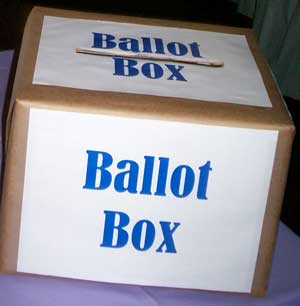
    13.Stuff the ballot box with forged proxies.
    14.
    Intimidating or bribing the owners for their proxies.
    15.Once the ballots had been counted, the manager "found" a couple more in her pocket that she added to the tally.
    16.When he saw the ballots laid out on the table, and it was obvious he lost his position, the president—who was chairing the meeting— shouts out that the meeting is over and he stormed out of the room.
    Later the corporation lawyer, who was not present during the meeting, claimed that the Annual General Meeting technically did not happen because no one took minutes.
    17.After the balloting, the manager, the district manager and the three directors go into a locked room and count the proxies and ballots. No owners are allowed to observe.

    When they come out, they declare that the bylaw was passed.

    How to discourage fraud
    I would love to write a guide on how to eliminate election fraud but unless the Condominium Act is radically changed, I don't think that it is possible.

    However, it is possible to discourage election fraud by:
    1.Have as many owners as possible learn the Nathan's Meeting Rules that deal with Annual General Meetings so they know what is going on during the owners' meetings.
    2.If possible, get a bylaw passed stating that the chair for all owners' meetings must be a disinterested third party.
    3.Demand that the owners have the volunteer scruintineers monitor the registration process prior to the start of the meeting along with counting the ballots.
    4. If the chair is openly biased, call a motion to replace the chair.
    5.If you suspect that fraud is likely, have a lawyer, who is experienced
    in condominium law, attend the meeting. Insure that he or she has a
    valid proxy.
    6.If you think that there are proxy irregularities, demand to inspect the ballots and the proxies during the meeting, not afterwards.
    7.If you suspect election fraud, say so at the meeting and demand that your suspicions be recorded in the minutes. If you do not complain about the irregularities then, it harms your credibility later in court.

    Preventing election misconduct and manipulation must become a priority.


    5 Real Estate Trends That Will Dominate 2016


    This year may have marked the best for housing since 2007, but the market will likely get even rosier in 2016, according to a recent real estate forecast by realtor.com®. One of the main drivers behind the brighter 2016 is the projection that employment will continue to grow, which will add to consumers’ wallets and allow them to purchase their first home or upgrade to a new one.
    Realtor.com® highlights the following housing predictions for 2016:

    1. ‘Normal’ is coming.
    Expect a healthy growth in home sales and prices – at a slower pace than in 2015. “This slowdown is not an indication of a problem—it’s just a return to normalcy,” writes Jonathan Smoke, realtor.com®’s chief economist. “We’ve lived through 15 years of truly abnormal trends, and after working off the devastating effects of the housing bust, we’re finally seeing signs of more normal conditions.” New construction and distressed sales are expected to return to more historical levels, and home prices are expected to follow at “more normal rates consistent with a more balanced market.”

    2. Generational buying trends shape up.
    Young adults’ presence on the housing market has been largely predicted for years, but 2016 may finally be the year they make a move in a larger way. Millennials represented nearly 2 billion sales in 2015 – one-third of home buyers. They are expected to continue to be a major buying pool in 2016 with the majority of buyers between ages 25 and 34 expected to be first-time home buyers next year. But two other generations will also have a big presence in 2016: financially recovering GenXers and older baby boomers who are entering retirement, realtor.com® notes. “Since most of these people are already homeowners, they’ll play a double role, boosting the market as both sellers and buyers,” Smoke notes. “Gen Xers are in their prime earning years and thus able to relocate to better neighborhoods for their families. Older boomers are approaching (or already in) retirement and seeking to downsize and lock in a lower cost of living.”

    3. New-home construction focuses more on affordability.
    Builders have been faced with higher land costs, limited labor, and concerns about the demand of the entry-level market. As such, they have shifted to constructing more higher-priced homes, which has caused new-home prices to rise significantly faster than existing-home prices. In 2016, they likely will shift to more affordable product to cater to the entry-level buyers. “We are already seeing a decline in new-home prices for new contracts signed this fall,” notes Smoke. “In addition, credit access is improving enough to make the first-time buyer segment more attractive to builders.”
    4. Higher mortgage rates.

    Mortgage rates will likely be volatile in 2016. But the recent move by the Federal Reserve to guide interest rates higher should push mortgage rates higher in the new year than the historical lows they have been at for years. The 30-year fixed-rate mortgage will likely end 2016 about 60 basis points higher than today’s level. “That level of increase is manageable, as consumers will have multiple tactics to mitigate some of that increase,” Smoke says. “However, higher rates will drive monthly payments higher, and, along with that, debt-to-income ratios will also go higher.” The markets with the highest home prices will see the effects from the higher rates the most.
    5. Rents to go up even higher.

    Rental costs are skyrocketing, and the costs are likely to only go up in the new year. More than 85 percent of the nation’s markets have rents that exceed 30 percent of the income of renting households. “Rents are accelerating at a more rapid pace than home prices, which are moderating,” Smoke says. “Because of this, it is more affordable to buy in more than three-quarters of the U.S. However, for the majority of renting households, buying is not a near-term option due to poor household credit scores, limited savings, and lack of documentable stable income of the kind necessary to qualify for a mortgage today.”

    UPDATE: Miami Beach: Drug lord Pablo Escobar’s former mansion to be torn down


    Miami Beach house was owned in the 1980s by Colombian drug lord Pablo Escobar

    U.S. authorities seized the mansion in 1987

    The house is now owned by Christian de Berdouare, who founded Chicken Kitchen, and his wife, journalist Jennifer Valoppi


    Using metal detectors, magnetometers, electric saws and other tools, three professional treasure hunters carefully searched an abandoned mansion on Miami Beach.

    They were not looking for old silver coins or gold bars from some Spanish galleon sunk in Biscayne Bay. The treasure they sought was bundles of dollars. In the worst of cases, maybe drugs or human remains.

    “Pablo Escobar used to launder a lot of money. He had so much that he could not launder it all, and it’s known that he hid barrels full of money all over,” said Nokolay Malchev, an inspector from Kellyco Metal Detectors.

    The mansion, rose colored with black roof tiles, was owned in the 1980s by Escobar, the Colombian drug lord who was one of the richest and most dangerous criminals of his era.

    Pablo Escobar used to launder a lot of money. He had so much that he could not launder it all, and it’s known that he hid barrels full of money all over. Nokolay Malchev, an inspector from Kellyco Metal Detectors.

    Christian de Berdouare, a businessman who founded the Chicken Kitchen fast-food chain, is the current owner of the property, 5860 North Bay Rd. He and his wife, journalist Jennifer Valoppi, will have the mansion demolished on Tuesday.

    “We want to close a very dark chapter in the history of Miami,” said Valoppi, who vividly remembers the violence that wracked Miami three decades ago, sparked by a war for control of the drug traffic. Escobar, she added, “killed so many people. We want to erase those memories and create something new and inspiring.”

    Only a banyan tree will remain on the 7,336-square-foot plot. A new house with a modern design and big picture windows will be built there, supervised by de Berdouare, who bought the mansion in 2014 for $9.65 million.

    The current mansion, with four bedrooms, six bathrooms, a pool and garage, was built in 1948. It has a marina and 150 feet of frontage on Biscayne Bay with a view of downtown Miami.

    Escobar, nicknamed “El Patrón” — The Boss — bought the property in March 1980 for $762,500, according to Miami-Dade County public records. The name Pablo Escobar is listed in a document transferring ownership of the property.

    Although it’s not clear whether the Medellín Cartel chief ever lived in or even visited the property, Jim Shedd, a former Drug Enforcement Administration agent, told the owners that it’s very probable the property was used as a hideout by Escobar’s gunmen and a landing point for tons of cocaine.

    U.S. authorities seized the mansion in 1987, along with $20 million that the Colombian trafficker had in several properties around Florida. He was killed in a shootout with Colombian authorities in 1993.
    Attorney Roger Schindler bought the house from the U.S. government in 1990 for $915,000. The mansion was abandoned several years ago after a fire destroyed at least two rooms, the current owners said. During that time, the property was vandalized, some of its walls covered in graffiti, some windows broken.

    Holes punched in the walls indicate that someone may have been searching for valuable objects left behind by the drug traffickers, according to the treasure hunters.

    De Berdouare said he’s not interested in remodeling the mansion and using the notoriety of its former owner to rent it for special events, following the example of a group of business people who last year bought Al Capone’s mansion on Palm Island.

    “We were there for a wedding and met the owners of the house. They told us that they were not getting the return on their investment that they were expecting. It’s clear that this is not an easy undertaking,” the businessman said.

    De Berdouare said he and Valoppi have not decided whether they will sell the new mansion once it’s built.

    “We own three properties on this street. Depending on which one sells, we might move to this one when it’s ready,” he said.

    Meanwhile, ONE Sotheby’s International Realty, representing the owners, has put a value of $21 million on the future mansion.